
Pitch / Frequency
Octaves, doubling and frequency shifting.
| Module | In short |
|---|---|
| Mono Octaver | Sub-octave layers follow single notes; Dry retains the pick attack. |
| Stereo Doubler | Opposite detuning and delay suggest a second take; Spread widens it. |
| Frequency Shifter | Hertz offsets make metallic sidebands; Feedback shifts each repeat. |
Mono Octaver
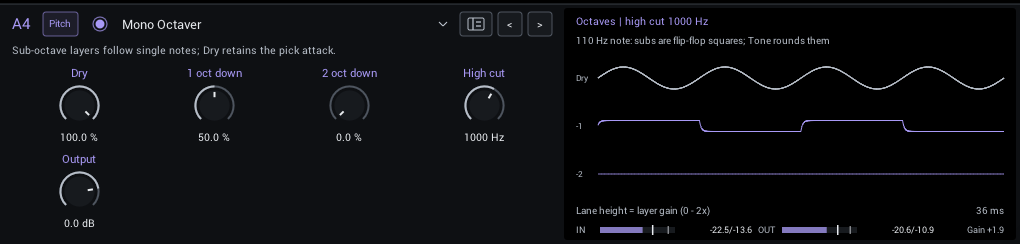
Add one or two octaves below single notes. High cut rounds the generated tone. Play cleanly: chords and weak fundamentals confuse tracking.
| Control | Range | Start | What it does |
|---|---|---|---|
| Dry | 0–100% | 100% | Level of the original guitar alongside the generated sub-octaves. |
| 1 oct down | 0–100% | 50% | Level of this generated sub-octave. Best tracking comes from clean, single-note playing. |
| 2 oct down | 0–100% | 0% | Level of this generated sub-octave. Best tracking comes from clean, single-note playing. |
| High cut | 80–5000 Hz | 1000 Hz | High-cut frequency for the generated sub-octaves; the dry guitar keeps its original tone. |
| Output | -24 to +6 dB | 0 dB | Final level. Match bypass volume when comparing tones. |
Display: A 110 Hz note and the two sub-octave square waves.
Stereo Doubler
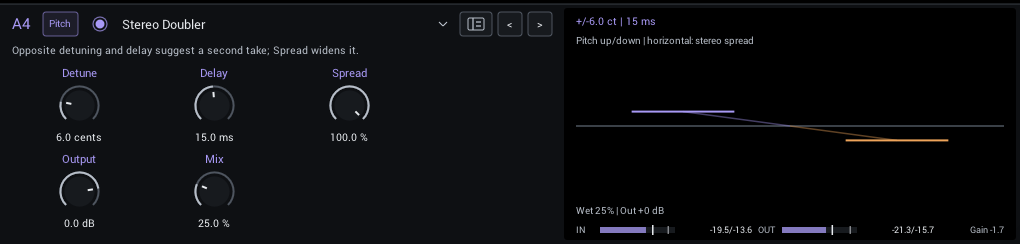
Opposite pitch detuning and short delays on the left and right suggest a second take.
| Control | Range | Start | What it does |
|---|---|---|---|
| Detune | 1–25 cents | 6 cents | Opposite pitch offsets in cents; higher settings make a wider, more obvious double. |
| Delay | 1–30 ms | 15 ms | Base separation before each detuned voice; increases the double-tracked feel. |
| Spread | 0–100% | 100% | Spread of detuned voices; zero centers the wet pair, 100 keeps them on opposite sides. |
| Output | -24 to +6 dB | 0 dB | Final level. Match bypass volume when comparing tones. |
| Mix | 0–100% | 25% | Balance between dry sound and effect. |
Display: Pitch up and down against the stereo spread.
Frequency Shifter
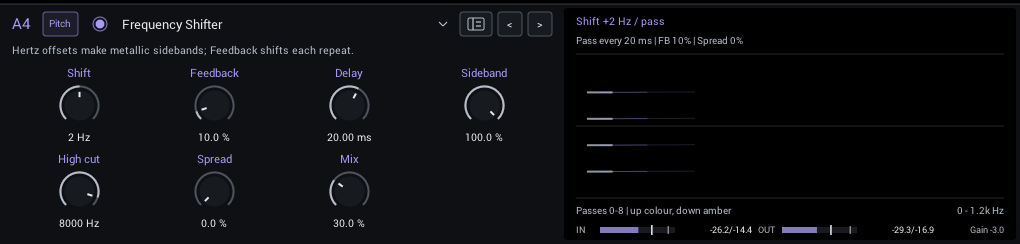
Move every partial by the same number of hertz for metallic, shifting, and continuously rising or falling textures. This is not a musical pitch shifter.
| Control | Range | Start | What it does |
|---|---|---|---|
| Shift | -2000 to +2000 Hz | 2 Hz | Fixed hertz offset per pass; unlike a pitch shifter, every partial moves by the same number of hertz. |
| Feedback | 0–100% | 10% | Return shifted audio into the delay for progressively changing repeats. |
| Delay | 0.05–1000 ms | 20 ms | Time between shifted feedback passes; short settings smear, long settings make distinct echoes. |
| Sideband | -100 to +100% | 100% | Lower sideband at -100, ring modulation at zero, upper sideband at +100. |
| High cut | 200–12000 Hz | 8000 Hz | High-cut frequency of the processed signal. Lower values tame brightness and harshness. |
| Spread | 0–100% | 0% | Carrier phase difference between channels; widens the shifted texture. |
| Mix | 0–100% | 30% | Balance between dry sound and effect. |
Display: How each pass through the feedback moves the partials.